sudokuEd wrote:If it did still need that chain, here's a way that looks simpler for step 4.
Love this chain, Ed! Indeed, I think it's an example of a
Grouped Turbot Fish, which is a specific type of
AIC. Before discussing it in more detail below, I'd like to first of all present an example of a grouped turbot fish taken from a regular Sudoku, found with the help of
JSudoku (thanks J-C!):
Code: Select all
.-----------------------.-----------------------.-----------------------.
| 8       7       6     | 5       4       1     | 23      9       23    |
| 125     125     12    | 9       3       6     | 4       78      78    |
| 9       3       4     | 78      78      2     | 56      56      1     |
:-----------------------+-----------------------+-----------------------:
| 16      4       178   | 2       15689   578   | 589     3       68    |
| 12367   128     5     | 13678   16789   4     | 289     128     268   |
| 1236    9       128   | 1368    1568    358   | 7       1258    4     |
:-----------------------+-----------------------+-----------------------:
| 17      18      3     | 1678    2       9     | 68      4       5     |
| 4       258     278   | 368     568     3578  | 1       2678    9     |
| 125     6       9     | 4       158     578   | 238     278     2378  |
'-----------------------'-----------------------'-----------------------'
From this position, the following grouped Turbot fish can be applied:
Code: Select all
(1)R4C13=R4C5-R9C5=R9C1 => R56C1<>1
In other words, if R4C13 do
not contain a 1, then R4C5
must be 1 (strong link R4), implying that R9C5
cannot be 1 (weak link C5), in turn implying that R9C1
must be 1 (strong link R9). Thus, (even) if R4C13 do not contain a 1, R9C1 must be 1. Expressed differently, at least one of the two chain ends must contain a 1, thus allowing the digit 1 to be removed from the
common peers R56C1.
Note that a turbot fish is an AIC where all links are based on the same digit. In this case, it's a grouped turbot fish on (the digit) 1 with 3 links, where the term "grouped" refers to the use of a multi-cell node at R4C13. As is traditionally the case with AICs in general, the chain begins and ends with a strong link.
Now let's turn our attention to Ed's move, using the marks diagram he presented above. Here, Ed used bifurcation based on two possible locations for the digit 7 in N1, namely R2C2 and R12C3. This is, however, simply making use of the fact that there is a
grouped strong link between R2C2 and R12C3, allowing us to reformulate his chain in standard AIC form as follows:
Code: Select all
(7)R9C1=R78C3-R12C3=R2C2 => R9C4<>7
In other words, if R9C1 does
not contain a 7, then R78C3
must contain a 7 (strong link N7), implying that R12C3
cannot contain a 1 (weak link C3), in turn implying that R2C2
must be 7 (strong link R9). Thus, (even) if R9C1 does
not contain a 7, R2C2
must do. This allows us to eliminate the candidate 7 from R9C4, even though this is not a common peer of both chain end nodes. This is because the general rule for AICs is that
we can eliminate any candidate that is weakly linked to both end nodes, which (as in this case) includes any such candidates in cells that are not directly seen by either (or even both) ends of the chain.
In this case, one of the weak links is complex, in that it depends on the possible combinations ({267/289/379/469}) for the innie/outie difference cage at R2C2+R9C34, none of which contain multiple occurrences of the digit 7. Therefore, a 7 in R2C2 precludes a 7 in R9C34.

 ) and tell us about it, maybe we can encourage him to come out of puzzle retirement and make another new one for us.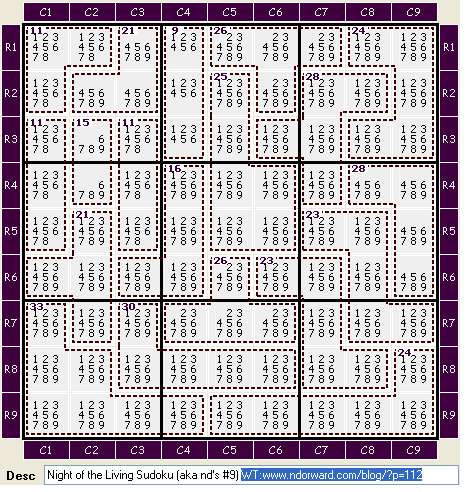
 5378
5378 6660:6660:6660:6151:6151
 3859
3859 2307:6413:7183:7183:6151:6151
 It's great to have another WT from a sudocue.net regular to compare with nd's blog and udosuk's analysis.
 (<-- very surprised, because I would have expected a 1.75 - or even a 2.0
  - here, due to need for a chain to break the deadlock).
 )
)